
 AS/RS Handling Robot
 Vertical Storage Module
 Conveying Equipment
 Smart Warehousing System
 Warehouse Racking
 Industries
 Services
 About Us



Pallet Deflection Inspection for AS/RS: Identifying Deformation Before Storage
A pallet may carry its load without being suitable for an Automated Storage And Retrieval System (AS/RS).
A loaded pallet can travel normally along a roller conveyor, then sag noticeably when its support conditions change during storage or Stacker Crane handling. The first signs may be restricted fork entry, a jam at a transfer point, or recurring position detection errors. If troubleshooting focuses entirely on the conveyor and its sensors, the pallet itself can be overlooked.
Pallet deflection inspection helps identify this risk before the load enters storage. Its effectiveness depends on whether the support arrangement, inspection points and acceptance criteria reflect actual operating conditions. The methods and project experience described : establish how the loaded pallet is supported before choosing how to inspect it.
Why a Pallet Can Run Normally on a Conveyor but Sag in Storage
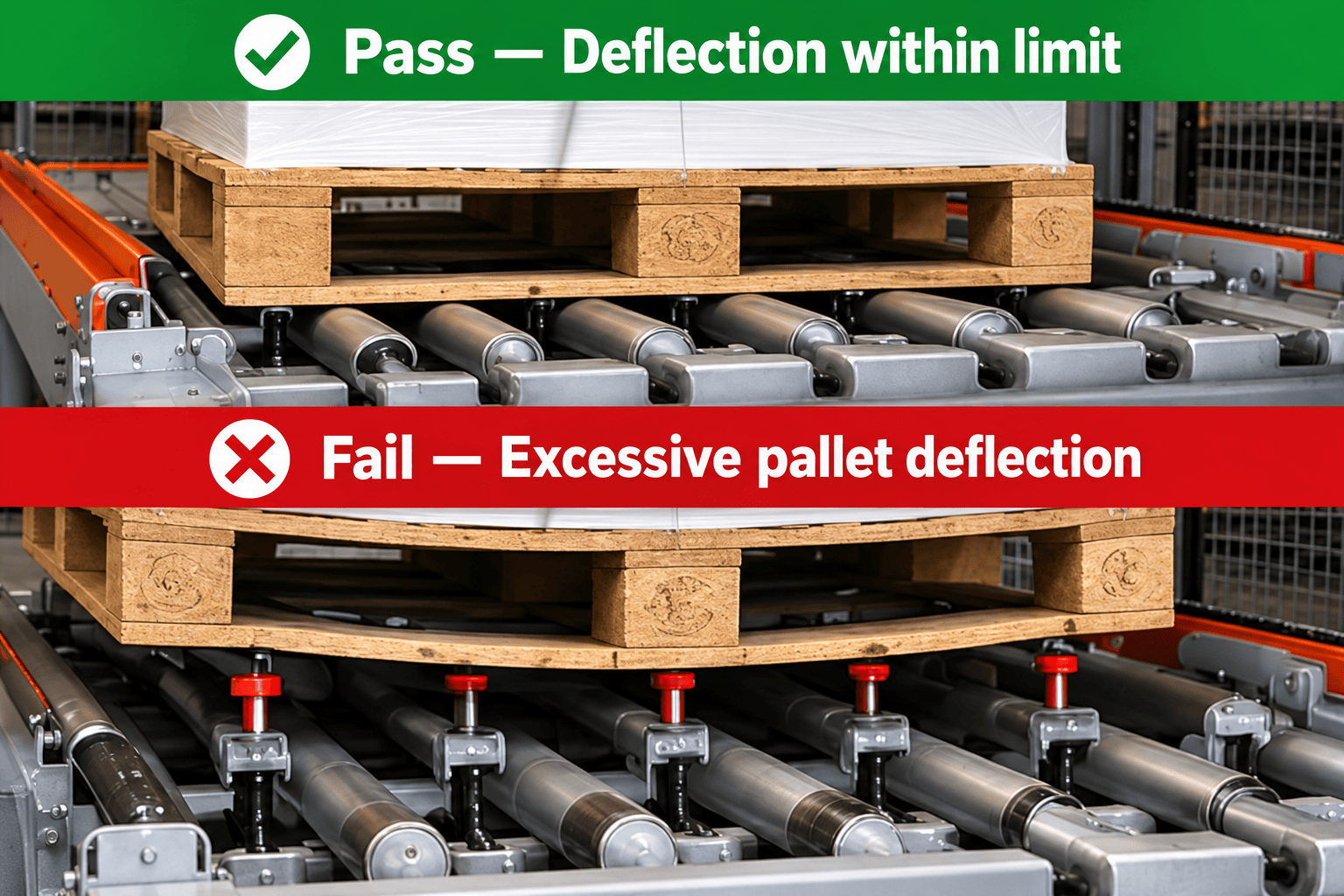
Pallet deflection is the bending that occurs under load. In an automated warehouse, the practical concern is whether that bending interferes with support, conveying or load handling.
Roller conveyors support the pallet at several points and can temporarily restrain deformation. Once the pallet is placed on a rack, the support positions change. Unsupported sections carry the load across a different span, and the resulting deflection can change accordingly. A height check performed while the pallet rests on rollers may therefore give an incomplete picture of its behaviour in storage.
Deformation also affects the interfaces between equipment. A sagging section can catch on the frame at a roller gap or transfer point. Upward bowing can prevent the pallet from sitting properly on the conveyor, while diagonal twisting can produce uneven support and skewed travel. Changes in height may also interfere with photoelectric position detection, fixed barcode scanning and lift-and-transfer mechanisms.
Recurring conveyor faults should therefore prompt an examination of pallet condition alongside equipment checks. Adjusting a transfer point may improve clearance, but it cannot remove deformation within the loaded pallet.
Lift-Up Inspection Removes the Restraint Provided by Conveyor Rollers
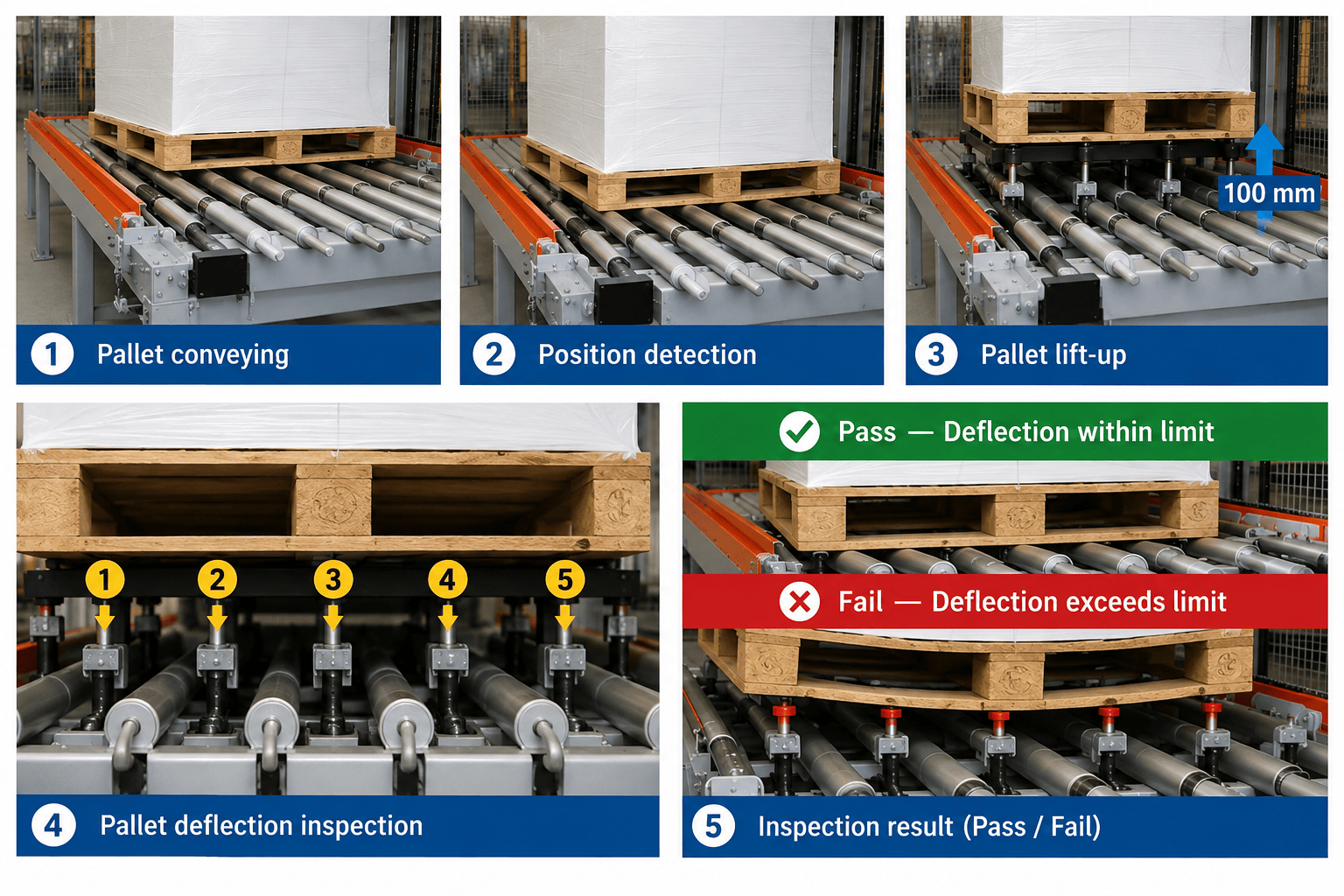
In the lift-up arrangement , a loaded pallet first moves into the inspection position. A lifting mechanism raises it clear of the rollers, and several sensors beneath the pallet check changes in bottom-runner height.
The mechanism uses a 100 mm lifting stroke. The purpose is to remove roller support and expose bending under load, using a defined support arrangement to simulate racking conditions. During project design, the lifting support positions need to be checked against the actual rack arrangement. Lifting height alone does not establish that the inspection reproduces the relevant loading condition.
Sensor placement deserves equal attention. A single measurement at midspan can miss defects in another runner or a localised area. Multiple inspection points provide information about deformation at different positions. Where diagonal twisting must also be detected, additional height checks at the four corners are required.
The study gives ±10 mm as an example threshold drawn from engineering practice and explicitly states that it must not be adopted universally. The allowable value needs to account for pallet material, dimensions, rack support span and applicable requirements. An acceptance limit detached from those conditions is an insufficient basis for project acceptance.
In-Motion Inspection Must Account for Conveyor Direction
For plastic pallets with three parallel bottom runners, the study describes inspection on a Chain Conveyor while the pallet passes through the station. The system checks whether a runner crosses a preset boundary, without lifting each pallet for a separate inspection.
A roller-lever microswitch provides a mechanical threshold check with relatively low hardware cost. It can suit one-way conveying, but the arrangement described has a specific restriction: a rejected pallet must continue forward to the exception outlet. Reversing it can damage the switch mechanism. A reverse-motion interlock is therefore part of the control requirement.
Laser and photoelectric arrangements avoid the same mechanical interference and can accommodate forward and reverse travel. The study reports an overseas AS/RS installation where photoelectric switches on a chain conveyor inspect all three runners of a plastic pallet as it passes. The application illustrates why inspection layout must be developed around the pallet’s underside geometry.
Optical sensing also requires a distinction between detecting an excessive deflection and measuring its magnitude. A conventional beam-interruption photoelectric sensor primarily provides a switching signal. Recording actual deflection requires a sensor with the appropriate measurement capability, correctly installed and calibrated. An optical inspection station does not automatically produce deflection readings in millimetres.
Steel Pallet Inspection Still Requires Mechanical Maintenance
The steel pallet arrangement in the study combines a follower roller, a pivoting lever and a metal target with an inductive proximity switch. Downward movement of the pallet runner moves the lever. When the target reaches the preset sensing position, the switch produces an excessive-deflection signal.
The proximity switch itself does not touch the pallet, reducing its exposure to impact. The arrangement also supports the bidirectional conveying and dusty or metal-chip environments discussed. However, the follower roller remains a contacting mechanical component and needs to be checked for wear.
This method provides a pass/fail signal rather than a numerical deflection reading. Temperature and nearby metal can affect the switching distance, making periodic recalibration necessary. The study also advises against pointing the proximity switch directly at the pallet’s steel runner: welds and positioning variations can cause false alarms or missed defects.
A separate, simpler option uses a horizontal through-beam laser at a defined height. A sagging section interrupts the beam and triggers an alarm. This can identify substantial downward deformation, but its ability to detect small deflections or upward bowing is limited. Passing this check cannot establish that every part of the pallet is free from deformation.
Positioning and Exception Handling Determine Whether Inspection Works Reliably
A threshold produces comparable results only when pallets arrive in a consistent inspection position. The study calls for positioning stops ahead of the inspection station to prevent pallet displacement from generating repeated false alarms.
The response to a failed inspection should also be defined during design. An excessive-deflection signal should prevent further movement towards storage and route the pallet to an exception station. Personnel can then confirm its condition and determine whether repair or scrapping is appropriate. The rejection route is particularly important for mechanical arrangements that prohibit reverse travel.
Maintenance determines whether the original threshold remains dependable. For microswitch and proximity-switch follower mechanisms, the study recommends quarterly checks using gauge blocks and a dial indicator, together with inspections of roller wear, brackets and locking fasteners. Optical sensors require lens cleaning, checks of any air-purge provision and periodic verification of measurement accuracy.
When false alarms increase, these conditions should be checked before changing the acceptance threshold. Widening the limit may reduce alarms while allowing pallets that should have been rejected to enter storage.
Plastic Pallet Creep Extends Beyond What an Online Check Can Reveal
Plastic pallets are subject to creep: deformation can gradually increase under a sustained load. Passing a brief inspection at the storage entrance cannot establish that the pallet will retain the same shape after an extended period on the rack.
This is one reason inspection under the actual goods load matters. Some defects become apparent only after loading, even when an empty pallet looks undamaged. Multiple inspection points help identify local sagging, upward bowing and twisting, with additional corner checks where required. Laser sensor settings also need on-site adjustment to account for differences in plastic surface reflectivity.
For pallets used in extended rack storage, the study recommends periodic sampling for a 24-hour rack creep test to review deformation under sustained loading. The scope of this recommendation matters.
Laboratory static load testing has a further role. Defined support and loading arrangements allow pallet deflection and stiffness to be evaluated. The applicable standard and complete test procedure must be checked before testing. A single conveyor-based threshold check cannot replace an assessment of pallet load-bearing performance.
Include Pallet Inspection Conditions in the AS/RS Specification
Pallet deflection inspection should be specified around the intended operation: pallet construction, goods load, rack support arrangement, conveyor direction and the information required from the inspection. A station intended to reject excessive deformation has different sensing requirements from one expected to record numerical measurements.
The engineering experience in the study shows how mechanical design, sensor placement and control logic work together at the storage entrance. Loaded deformation must be exposed, rejected pallets need a defined route out of the main flow, and the risks associated with prolonged storage require supplementary testing. These conditions give the inspection station a clear and useful role throughout warehouse operation.
Technical source: Gong Yuanchun, Chemical Industry Planning Engineer(Study on Pallet Deflection Detection During Conveying in Automated Warehouses).