
 AS/RS Handling Robot
 Vertical Storage Module
 Conveying Equipment
 Smart Warehousing System
 Warehouse Racking
 Industries
 Services
 About Us

Insights
0102030405
Dual-Station Tote Four-Way Shuttle Robot: Faster Tote Flow for High-Throughput ASRS
2026-08-17
In many tote ASRS projects, the first problem customers notice is storage density.
But after the system starts running at a higher order frequency, another problem becomes more obvious: tote flow.
The warehouse may have enough storage locations, but if tote retrieval is slow, picking stations still wait. If Shuttle Robots spend too much time on empty travel, system throughput is limited. If inbound, outbound, return, and picking tasks are not combined efficiently, the ASRS may not fully release its capacity.
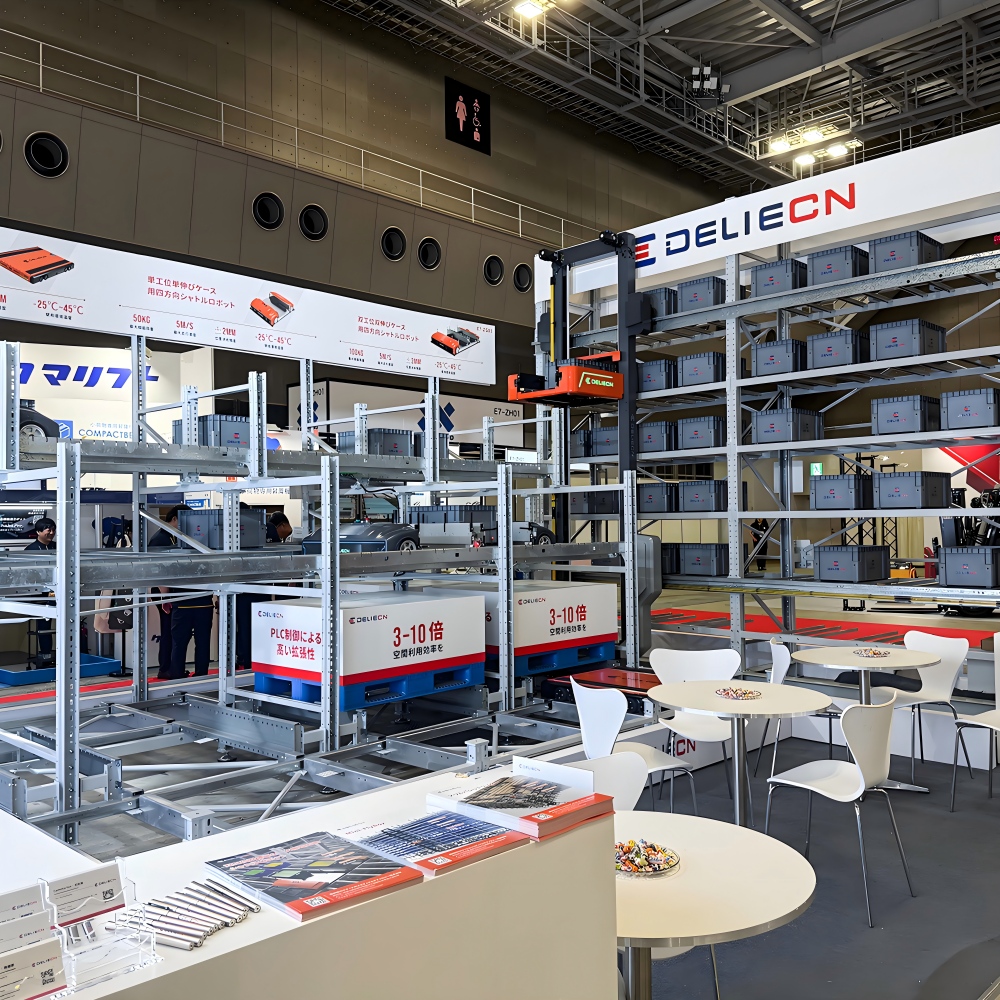
DELIECN developed this product for high-throughput tote Storage And Retrieval scenarios. Compared with a single-position shuttle robot, the dual-station design allows the robot to handle two tote positions in one operating cycle, helping improve tote transfer efficiency and reduce unnecessary movement inside the rack system.
The Real Bottleneck Is Often Not Storage Space
For e-commerce, retail, pharmaceuticals, spare parts, electronics, and manufacturing material warehouses, small and medium-sized items usually create a high number of order lines.
These warehouses often share several characteristics:
many SKUs frequent retrieval fragmented orders short picking windows
many SKUs frequent retrieval fragmented orders short picking windows
In this type of operation, tote ASRS performance depends on more than rack capacity. The key question is whether the system can keep totes moving smoothly between storage locations, lifters, conveyors, and picking stations.
A single-position shuttle can work well in many projects. But when task frequency becomes higher, each cycle may include more waiting, more return movement, or more empty travel. The dual-station structure is designed to improve this part of the operation.
Two Tote Positions, More Useful Movement per Cycle
The biggest difference of DELIECN Dual-Station Tote Four-Way Shuttle Robot is itsdual-position handling design. Instead of handling only one tote position in each operating cycle, the robot can carry and process two tote positions according to task requirements.
This creates more room for task combination. For example, in suitable operating scenarios, the robot can support storage, retrieval, transfer, return-to-storage, and tote rearrangement tasks with fewer unnecessary movements. The system can make better use of each shuttle trip, especially when inbound and outbound tasks are running at the same time.
For customers, the value is direct: the shuttle is not only moving faster; it is making each movement more useful.
This is important in high-throughput tote ASRS, where a small reduction in empty travel can improve overall workstation response.
Speed and Accuracy Need to Work Together
In tote ASRS, speed alone is not enough. A Shuttle Robot may move quickly inside the rack system, but if positioning is not stable, tote transfer between the rack, lifter, conveyor, and workstation can become unreliable.
5 m/s
Max Travel Speed
±2 mm
Positioning Accuracy
DELIECN Dual-Station Tote Four-Way Shuttle Robot supports travel speed up to5 m/s and positioning accuracy of ±2 mm. This helps the system maintain both retrieval speed and transfer stability.
The robot also supports 100 kg load capacity, making it suitable for higher-load tote or carton applications where two-position handling needs stronger structural support.
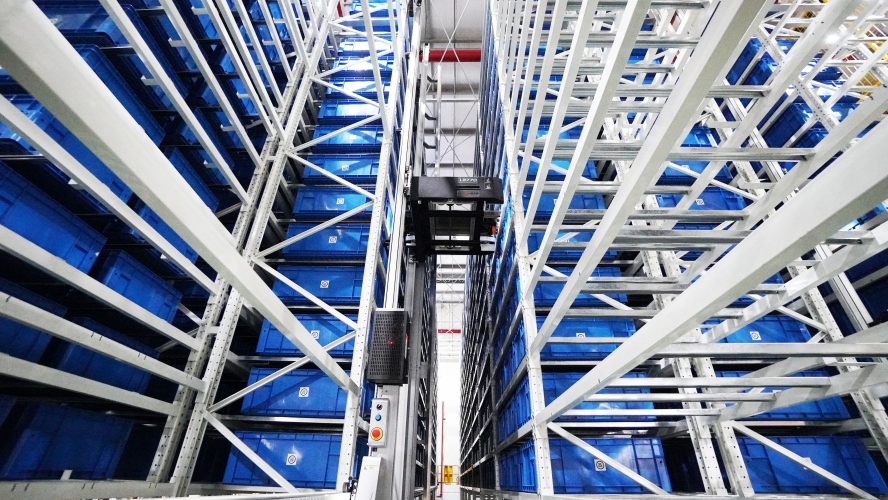
Four-Way Movement Inside the Rack System
The robot moves along both main and sub-aisle directions inside the rack system. This four-way movement allows the system to access different lanes, switch routes, more flexibly than fixed-lane systems.
With tote lifters and conveyors, the Shuttle Robot can support multi-level storage and goods-to-person picking flow. For warehouses with changing SKU demand, this flexibility is important. Fast-moving SKUs, slow-moving SKUs, return totes, and replenishment tasks may all need different storage strategies during different periods.
Flexible Storage Configuration for Different Tote Layouts
Not every tote ASRS uses the same layout. Some projects need single-deep storage for faster access. Some use double-deep storage to increase density. Some require different tote or carton widths.
DELIECN Dual-Station Tote Four-Way Shuttle Robot supports single-deep and double-deep configurations. This does not mean every project should use the same configuration.
- For high-frequency picking, faster access may be more important.
- For high-density storage, double-deep configuration may be more suitable.
- For mixed tote formats, fork adaptability becomes more valuable.
The final design should still follow the customer’s SKU structure, order rhythm, tote size, and throughput target.
Where This Product Creates the Most Value
The dual-station design is especially useful when a warehouse needs to handle a high volume of tote tasks within limited time. Typical scenarios include:
- high-SKU e-commerce fulfillment
- pharmaceutical picking
- automotive spare parts and components storage
- electronics and precision parts warehouses
- retail and apparel cosmetics and daily goods storage
- manufacturing material preparation
- goods-to-person picking systems
The product is most suitable where tote movement is frequent and workstation waiting time needs to be reduced. It is not only a storage robot. It is a tote flow efficiency tool.
Customer Value
For customers planning a high-throughput tote ASRS, the Dual-Station Tote Four-Way Shuttle Robot can help improve several parts of the operation.
- It can reduce unnecessary empty travel.
- It can improve tote transfer efficiency.
- It can support faster retrieval and return flow.
- It can help picking stations receive totes more continuously.
- It can improve the balance between storage density and picking response.
- It can support high-SKU, high-frequency order processing with more stable tote movement.
The value is not simply “two totes instead of one.” The real value is that the system can create better task combinations inside the ASRS, which helps the whole warehouse respond faster during peak order periods.
What to Consider Before Choosing Dual-Station Design
Dual-station shuttle robots are not only about increasing equipment specifications. Before choosing this configuration, customers should first review several project factors:
How many SKUs need frequent picking?
How many totes need to be retrieved per hour?
Are inbound and outbound tasks running at the same time?
How much workstation waiting occurs during peak hours?
Is the warehouse more limited by storage density or tote response speed?
When these questions are clear, the dual-station design can be applied more accurately. For some warehouses, a single-position shuttle may already be enough. For high-throughput tote ASRS, however, the dual-station design can provide a stronger balance between speed, density, and task efficiency.
Planning a high-throughput tote ASRS?
Talk to DELIECN about Dual-Station Tote Four-Way Shuttle Robot solutions for high-SKU storage, goods-to-person picking, and faster tote flow.
Follow DELIECN on LinkedIn for more product insights and warehouse automation case studies.