When a manufacturing plant becomes more digital, the warehouse cannot remain a separate manual process.
Materials still need to be received, stored, retrieved and delivered to the right production process. In a more connected factory, these movements also need to fit the production process, material information and equipment control.
This was the starting point for a welding-wire warehouse project at a structural-parts manufacturing facility.
The requirement was not simply to add more storage positions.
The warehouse had to work within a relatively limited building height, accommodate different material units, support a defined daily material flow and connect storage with the factory's production logistics.
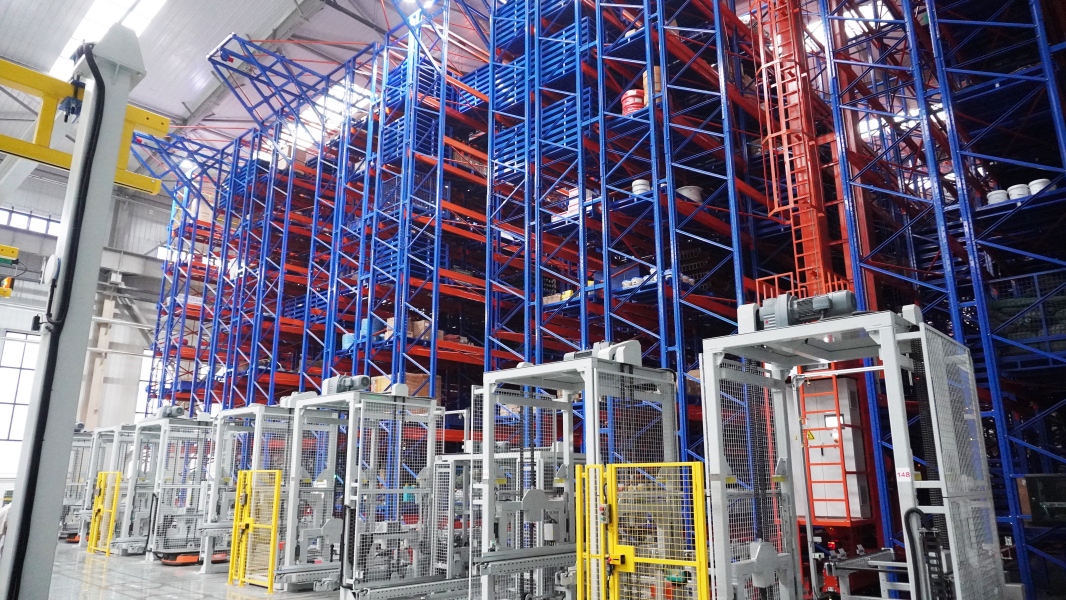
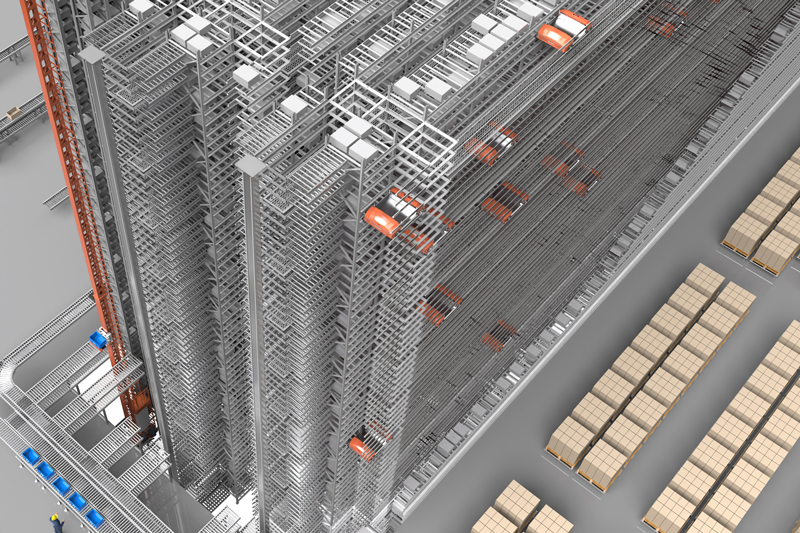
The final design used a Pallet Four-Way Shuttle AS/RS, supported by Pallet Lifters, conveyors, handling equipment, a gantry robot and warehouse control software.
The important part of the project is how these elements were arranged around the actual materials and handling requirements.
The Warehouse Had to Fit the Factory
The storage structure is approximately 6.9 m high, with five storage levels and 1,350 mm level spacing.
Within this space, the system needed to accommodate two different material units:
- • 1,300 × 800 × 900 mm welding-wire units
- • 1,300 × 800 × 700 mm steel material frames
• The final layout provides 893 effective storage locations:
- • 750 locations for 900 mm welding-wire units
- • 143 locations for 700 mm steel material frames
Each storage position was designed for a load of at least 1,000 kg.
The planned material-handling requirement was up to 180 pallet or steel-frame units per working day.
This combination created a specific engineering problem.
The rack had to make efficient use of a relatively low warehouse while accommodating two different load heights and heavy material. At the same time, the system needed to reduce unnecessary manual movement around the warehouse.
The design therefore started with the building, the load units and the material flow rather than with a particular machine.
Why a Pallet Four-Way Shuttle Was Selected
At approximately 6.9 m high, the warehouse did not simply need maximum vertical storage.
It needed a storage method that could use the available footprint efficiently while allowing storage positions to be arranged in a multi-deep configuration.
A Pallet Four-Way Shuttle Robot can travel longitudinally and transversely within the rack and change direction between the main and sub-aisles.
For this project, two Pallet Four-Way Shuttle Robots were included.
The design calculation rates each shuttle at approximately 20 pallets/hour, giving a calculated combined capacity of 40 pallets/hour for the two robots.
Two Pallet Lifters were also included, with a design capacity of approximately 40 pallets/hour per lifter.
These figures should be viewed as part of the complete material-flow calculation rather than as standalone equipment performance.
The shuttle, lifters, conveyors and front-end handling equipment all need to work together. A faster individual machine would not solve a capacity problem if another interface became the bottleneck.
The Load Carrier Was Part of the Automation Design
One of the less visible decisions in this project was the design of the load carrier.
The welding-wire units were not treated as generic pallets.
The project used custom steel pallets with mechanical positioning stops.
During manual loading, the positioning structure helps operators place welding-wire drums consistently. During outbound handling, it provides a repeatable position for the gantry robot to grip the load.
This matters because automated equipment depends on predictable load positions.
A robot can provide precise movement, but it cannot remove unlimited variation from the material being handled.
By controlling the position of the load at the pallet level, the project created a more consistent interface between manual loading, Automated Storage, retrieval and robotic handling.
For this application, the pallet is therefore more than a carrier.
It is part of the automation interface.
Inbound and Outbound Do Not Use Exactly the Same Route
The project does not force welding-wire units and steel material frames through exactly the same handling process.
For inbound operations, a 1,000 kg-class KBK flexible crane is used at the warehouse interface. It supports the loading of welding-wire drums and steel material frames before they enter Automated Storage.
For outbound welding-wire handling, an automatic gantry robot performs the depalletizing operation. Its customized gripping structure holds the welding-wire unit during transfer and provides a controlled handover to the downstream conveying process.
Steel material frames can interface with an unmanned forklift AGV for their subsequent handling.
This arrangement reflects the actual material characteristics.
The warehouse provides a common Automated Storage structure, while the front-end and outbound equipment are adapted to the different ways in which each material needs to be handled.
The Storage System Was Designed Around Material Flow
The four-way shuttle handles Storage And Retrieval, but the connection between the rack and surrounding equipment is equally important.
The inbound and outbound handling equipment is arranged around the first-level main shuttle track. This helps reduce unnecessary transfer steps and creates a more direct connection between the Shuttle System,Pallet Lifters and front-end equipment.
The design also considers empty-pallet circulation.
When steel material frames are moved out of storage, the empty pallet can be lifted while the frame continues toward the relevant handling position.
These details do not usually appear in the headline specification of an AS/RS.
But they affect how the system works in daily operation.
A warehouse can have sufficient storage capacity and fast robots while still losing time if materials repeatedly wait at equipment interfaces.
For this reason, the project treats the rack, lifters, conveyors and handling equipment as one material-flow system.
WMS/WCS Connects the Warehouse With Production
Physical automation is only one part of the project.
The warehouse also needs to connect with the factory's digital environment.
The system uses WMS/WCS, together with API, ECS and HMS functions.
WMS manages warehouse-related information and tasks, while WCS coordinates equipment execution, task dispatching, equipment resources and operational monitoring.
The system also provides an interface with MES, allowing warehouse operations to connect with production-related information.
In practical terms, a storage task is no longer simply a decision to put a pallet into an available position.
The material needs to be identified, a storage location needs to be assigned, equipment needs to execute the task and the result needs to return to the information system.
The warehouse therefore becomes part of the factory's material-flow network rather than an isolated storage area.
Automation Also Has to Account for Maintenance
A manufacturing warehouse cannot be designed only around normal operation.
Maintenance and recovery also need to be considered.
The project provides maintenance access around the main shuttle paths, while safety doors around conveyor areas are interlocked with the equipment.
The four-way Shuttle System also incorporates load detection, obstacle detection, anti-slip measures, power-loss protection and low-battery warnings.
The control system also considers backup and emergency operating procedures.
For the customer, this addresses a practical question that is often overlooked during equipment selection:
What happens when the system needs maintenance or something goes wrong?
A production warehouse needs controlled recovery as well as automated operation.
What the Project Delivered
The completed project provides:
- • 893 effective storage locations
- • Five storage levels
- • 1,350 mm level spacing
- • 750 locations for 900 mm welding-wire units
- • 143 locations for 700 mm steel material frames
- • At least 1,000 kg load capacity per storage position
- • Two Pallet Four-Way Shuttle Robots
- • Two Pallet Lifters
- • KBK flexible crane for inbound handling
- • Gantry robot for welding-wire depalletizing
- • AGV interface for steel material frames
- • WMS/WCS and system interfaces
The more meaningful result is the connection between these individual operations.
Material loading → automated storage → retrieval → depalletizing → downstream handling → production
The warehouse is no longer simply a place where welding wire is stored until production needs it.
It becomes a controlled material-handling node within the manufacturing process.
For manufacturers working with heavy materials, different load dimensions and limited warehouse height, the project shows why the storage robot should not be evaluated separately from the pallet, lifting equipment, handling route and control system.
The useful automation is the one that makes the complete material flow more predictable.

 Industries
 Services
 About Us
 AS/RS Handling Robot
 Vertical Storage Module
 Conveying Equipment
 Smart Warehousing System
 Warehouse Racking